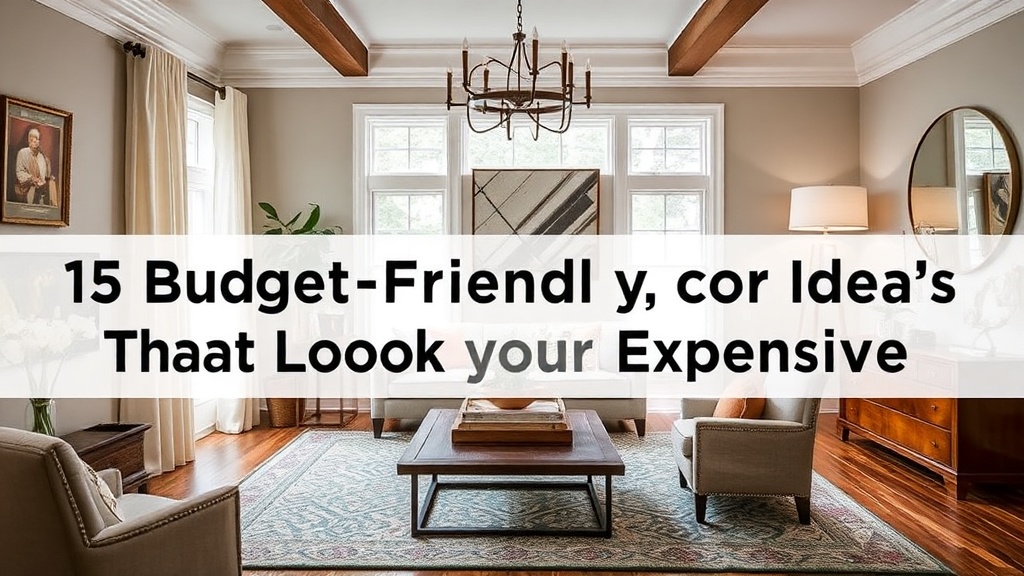
Transform Your Space: 15 Budget-Friendly Decor Ideas That Look Expensive

What This Post Covers (and Why Your Wallet Will Thank You)
This guide delivers fifteen proven, budget-friendly decorating strategies that create high-end looks without the luxury price tags. Whether you're refreshing a single room or tackling a whole-home makeover, these ideas prioritize smart spending over big spending. Beautiful spaces aren't reserved for those with unlimited funds— they're built through creativity, strategic shopping, and knowing which splurges actually matter. By the end, you'll have a practical toolkit for transforming any room while keeping costs firmly in check.
How Can You Make Cheap Furniture Look Expensive?
The answer lies in hardware, paint, and proper styling techniques that disguise budget origins.
That $35 thrift store dresser? It's hiding designer potential. Start by swapping out those flimsy plastic knobs for solid brass or ceramic hardware from Anthropologie or House of Antique Hardware. Quality pulls run $8-15 each but transform the entire piece. Here's the thing: hardware is jewelry for furniture. It draws the eye and signals craftsmanship—even on particle board.
Paint selection matters enormously. Skip the $15 gallon specials. Benjamin Moore Advance or Sherwin-Williams Emerald ($50-60/gallon) self-level beautifully and cure to a hard, enamel-like finish. Apply with a quality Purdy White Bristle brush and a microfiber roller. Two thin coats beat one thick coat every time.
Styling improves the ordinary. Stack hardcover books (thrift stores sell them for $1-2 each), add a small ceramic vase, and top with a trailing pothos. Suddenly that basic dresser reads "curated."
Quick Furniture Fixes Under $50
- Replace knobs and pulls on cabinets, dressers, and nightstands
- Add furniture legs to low-profile pieces using Waddell brand tapered legs from Home Depot
- Apply peel-and-stick wallpaper to drawer fronts or backing
- Swap standard lampshades for linen or pleated versions
- Reupholster dining chair seats with $8/yard fabric from Joann
Where Should You Actually Spend Money in a Budget Room?
Invest in seating comfort, lighting quality, and one statement piece that anchors the space.
The catch? Not everything deserves equal spending. A lumpy sofa ruins a room regardless of how beautiful the throw pillows are. That said, you don't need a $3,000 sectional. The IKEA Kivik ($599) or Article Sven ($1,299) offer solid construction and washable covers. Add a 3-inch memory foam topper ($80 from Linenspa on Amazon) if the cushions feel thin.
Lighting transforms mood instantly. Overhead fixtures create harsh shadows. Instead, layer three light sources per room: ambient (ceiling), task (reading lamps), and accent (sconces or candles). The Threshold globe table lamp from Target ($45) casts beautiful, diffused light. Pair it with Philips WarmGlow LED bulbs—they dim from 2700K to 2200K, mimicking sunset tones.
Your statement piece becomes the conversation starter. Hunt Facebook Marketplace, estate sales, and auction houses for authentic vintage finds. A $200 mid-century credenza or $150 Persian rug (yes, real ones—look for worn, "distressed" character) adds soul no mass-market item replicates.
What Paint Tricks Make Rooms Look Bigger and Brighter?
Use high-LRV colors, paint trim and walls the same shade, and extend ceiling color down onto walls by several inches.
Light Reflectance Value (LRV) measures how much light a color bounces back. Pure white hits 100; deep black sits at 0. For small or dark rooms, choose colors above 70 LRV. Benjamin Moore Chantilly Lace (92.2 LRV) and Sherwin-Williams Pure White (84 LRV) open spaces dramatically without feeling sterile.
Here's the thing about trim: contrasting white baseboards chop up small rooms visually. Painting trim the same color as walls (in a semi-gloss finish for durability) creates seamless expansiveness. Worth noting: ceiling paint matters. Most "ceiling white" reads dingy. Instead, cut your wall color with 25% white for the ceiling—this avoids the "hospital" look while maintaining cohesion.
The "colour drenching" technique—painting walls, trim, ceiling, and even built-ins in one saturated hue—creates cocoon-like sophistication. Try Farrow & Ball Hague Blue or Behr's Vintage Tea Rose for dramatic impact that actually feels intimate rather than overwhelming.
| Paint Finish | Best For | Durability | Cost per Gallon |
|---|---|---|---|
| Flat/Matte | Ceilings, low-traffic bedrooms | Low—scrubbing damages finish | $25-35 |
| Eggshell | Living rooms, dining rooms | Medium—occasional cleaning okay | $30-45 |
| Satin | Kitchens, bathrooms, trim | High—frequent cleaning holds up | $35-55 |
| Semi-Gloss | Trim, doors, cabinets | Highest—scrubbable and stain-resistant | $35-60 |
How Do You Decorate with Thrift Store and Flea Market Finds?
Edit ruthlessly, look for solid construction and interesting shapes, and repurpose items beyond their original intent.
The thrift store overwhelm is real. Acres of dusty knickknacks and mismatched dishware tempt you to walk out empty-handed. Success requires a hunting mentality. Scan for shape and material, not color. That ugly brown wooden bowl? Sand it, oil it with Howard Feed-N-Wax, and you've got a $3 organic centerpiece.
Brass candlesticks, wicker baskets, ceramic vases, and solid wood furniture age better than trendy pieces. Skip anything laminate, particle board, or made after 1990 (generally speaking—exceptions exist). Vintage linens make excellent pillow covers. Old hardcover books create height and interest on shelves.
Repurposing unlocks creativity. A wooden ladder becomes a blanket rack. Vintage suitcases stack into a side table. An old window frame transforms into a photo display with clips and wire. The Apartment Therapy archives contain thousands of real-world examples from actual homeowners who've mastered this approach.
Thrift Store Red Flags vs. Green Lights
- Green light: Solid wood drawers that glide smoothly, dovetail joints, brass hardware, wool rugs, leather (even worn), ceramic, glass, woven natural materials
- Red flag: Particle board, laminate peeling at edges, musty upholstered items (mold risk), anything requiring electrical rewiring unless you're qualified, pressed "wood" furniture from the 2000s
What Are the Best Budget Alternatives to Expensive Decor Trends?
Shop strategically—stone-look porcelain instead of marble, peel-and-stick tile rather than custom backsplashes, and quality art prints instead of originals.
Carrara marble countertops run $75-150 per square foot installed. MSI Carrara Grigio porcelain tile ($8/sq ft) delivers nearly identical visual impact with superior durability (no etching from lemon juice or wine). The same principle applies to flooring: luxury vinyl plank from LifeProof (Home Depot, $3-4/sq ft) convincingly mimics oak and holds up to pets, kids, and spills better than engineered hardwood.
Gallery walls intimidate people because original art feels expensive. It doesn't have to be. Downloadable art from Etsy ($5-15 per print) prints beautifully at Costco or MPix for $10-20 framed simply. Mix in personal photos, children's artwork in clean frames, and one "anchor" piece thrifted from estate sales.
Peel-and-stick wallpaper from Tempaper or RoomMates ($30-50 per roll) transforms rental bathrooms and awkward alcoves without landlord battles. It removes cleanly when you move out—tested and verified by thousands of apartment dwellers.
High-Low Swaps That Save Hundreds
- Art: Original oil painting ($300+) → Limited print + quality frame ($45)
- Rugs: West Elm wool rug ($800) → Rugs USA vintage reproduction ($180)
- Lighting: Schoolhouse Electric pendant ($400) → Progress Lighting similar style ($89)
- Storage: Built-in bookshelves ($3,000+) → Billy bookcases with added trim ($300)
- Mirrors: Anthropologie gilded mirror ($500) → Kirkland's or thrift store + gold leaf pen ($40)
How Do You Arrange Accessories Without Making Rooms Look Cluttered?
Group in odd numbers, vary heights and textures, and leave breathing room between objects.
The "three or five rule" isn't design-speak nonsense—it works because odd numbers force your eye to move around rather than creating static pairs. On a coffee table, combine a tall vase (12+ inches), a stack of two books with a small object on top, and a low bowl. Different heights create visual rhythm. Similar heights create boredom.
Texture mixing prevents flatness. Combine smooth ceramic with rough wood, shiny metal with matte fabric, organic shapes with geometric ones. A marble tray (thrifted, $4) corrals remotes. A woven basket (Facebook Marketplace, $10) holds throw blankets. A brass animal figurine (flea market, $3) adds personality and sparkle.
Negative space matters. Every surface doesn't need decoration. A mantel with three well-chosen objects beats one crammed with twenty tchotchkes. The eye needs rest. When in doubt, remove one item.
"The best rooms have something to say about the people who live in them." — David Hicks
Final Thoughts on Building Beautiful Spaces Slowly
Great rooms aren't bought—they're assembled over time through patience and curation. The pressure to "finish" a space immediately leads to regrettable impulse purchases and that catalog-showroom sameness everyone wants to avoid.
Start with your foundation: comfortable seating, good lighting, and a color palette you love. Add layers seasonally—a new textile here, a found object there. Hunt regularly but buy rarely. Live with empty walls until you find art that genuinely moves you.
The homes that feel most authentic reflect the people inside them. A $5,000 sofa doesn't tell your story. That ceramic bowl you found on a weekend road trip, the photo from your grandmother's house, the plant you've kept alive for three years—these create the warmth and character that no interior designer can manufacture. Beautiful homes don't require big budgets. They require attention, intention, and the confidence to trust your own eye.